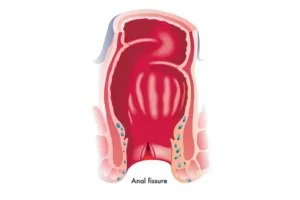
 It is an ulcer in the longitudinal axis of the lower anal canal. Commonly it occurs in the midline, posteriorly (more common in males), but can also occur in the midline anteri- orly (more common in females).
Ninety-five per cent of anal fissures in men are posterior; 5% are anterior. Eighty per cent of anal fissures in females are posterior; 20% are anterior. Anterior anal fissure is common in females. It is superficial, small but distressing lesion. Fissure ends above at the dentate line.
Causes:-
Because of the curvature of the sacrum and rectum, hard faecal matter while passing down causes a tear in the anal valve leading to posterior anal fissure.
- Anterior anal fissure is common in females due to lack of support to pelvic floor.
- Hard stool; diarrhoea; increased sphincter tone; local ischaemia; trauma; sexually transmitted diseases.
- Other causes—Haemorrhoidectomy, Crohn’s disease, vene- real disease, ulcerative colitis, tuberculosis.
Types:
Anal fissure can be acute or chronic.
- Acute Anal Fissure: It is a deep tear in the lower anal skin with severe sphincter spasm without oedema or inflammation.
It presents with severe pain and constipation. - Chronic Anal Fissure: It has got inflamed, indurated margin with scar tissue.
Ulcer at its inferior margin is having a skin tag which is oedematous, acts like a guard—sentinel pile.
Proximally hypertrophied anal papilla is observed.
It can cause repeated infection—fibrosis—abscess forma-tion—fistula formation.
Chronic fissure is less painful than acute one.
Multiple fissures are seen in inflammatory bowel disease, homosexuals and venereal diseases.
Chronic fissure can cause complications like—abscess, fistula formation.