Fistula By ProctoNova

A Complete Care

Fistula-in-Ano

It is a track lined by granulation tissue which connects peri-anal skin superficially to anal canal; anorectum or rectum deeply. It usually occurs in a pre existing anorectal abscess which burst spontaneously.


Fistula-in-ano can be:

  • Cryptoglandular—90%
  • Non-cryptoglandular (other causes)—10%.
Fistula

Classification

  • Low level fistulas—these open into the anal canal below the
    internal ring.
  • High level fistulas—these open into the anal canal at or
    above the internal ring.
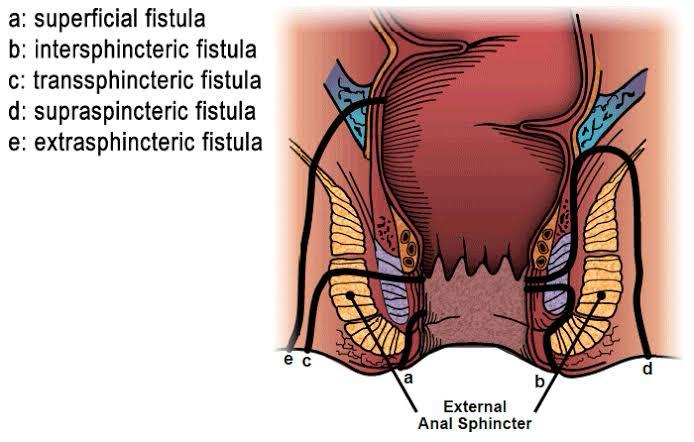
  • Intersphincteric fistula
  • Transphincteric fistula
  • Supralevator fistula
  • Extrasphincteric fistula.
  • Simple fistula without extensions.
  • Complex fistula with extensions.
  • Single external opening.

Multiple external openings which are often seen in-:

Tuberculosis, Ulcerative colitis, Crohn’s disease lymphogranuloma venereum (LGV), Hidradenitis Suppurativa, Actinomycosis.

The term complex fistula means—the track crosses >50% of the external sphincter, anterior in females, multiple tracks, recurrent, or the patient has preexisting incontinence, local irradiation, or Crohn’s disease.

Fistula

Principles of Management

Identify the cause cryptoglandular or other:-

  • Delineate exactly the fistula anatomy— MRI/EUS.
  • Identify relation of fistula to anal sphincter.
  • Drain all sites of infection.
  • Eradicate track and secondary extensions.
  • Preserve anal continence function.

The primary objectives are to eradicate the tract and drain all associated sites of infection while simultaneously preserving anal continence.

Help

Career

Privacy Policy

Terms of Services

F.A.Q.

Contact Us

ProctoNova © 2023 Copyright

Powered by Pinaki Digitals